
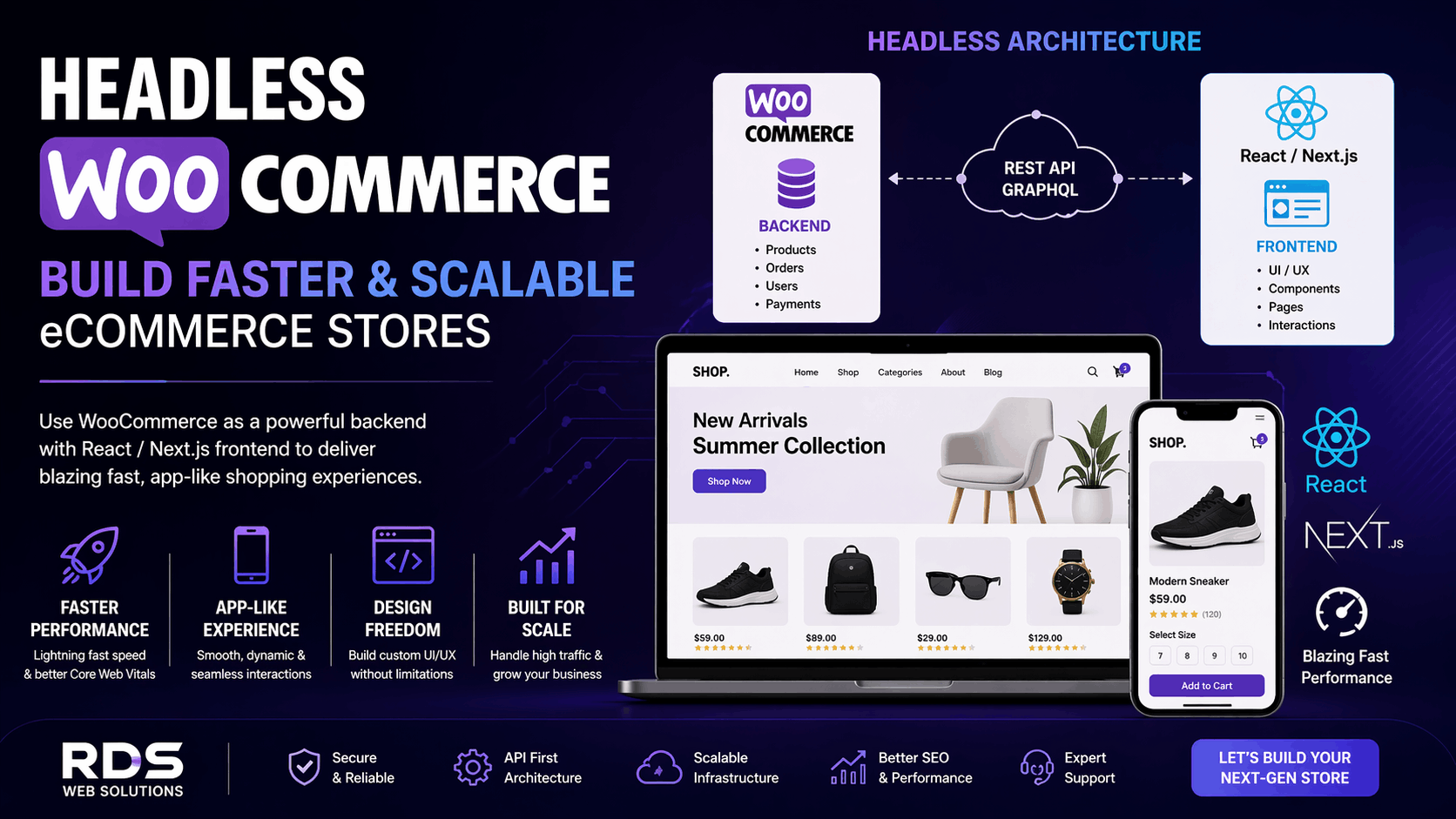
The eCommerce world is no longer just about having an online store—it’s about delivering lightning-fast, app-like experiences that convert visitors into customers. This is where Headless WooCommerce Development is changing the game.
Businesses that want speed, flexibility, and scalability are now moving beyond traditional setups and embracing modern architectures using WooCommerce as a backend and frameworks like React or Next.js for the frontend.
In this guide, we’ll break down everything you need to know—and why forward-thinking brands are switching to headless.
Headless WooCommerce means separating the frontend (what users see) from the backend (where data and logic live).
👉 In simple terms:
✔WooCommerce handles products, orders, payments
✔React / Next.js handles design, UI, and user experience
These two communicate via APIs.
While WooCommerce is powerful, traditional setups come with limitations:
✔Slower page load speeds
✔Limited frontend flexibility
✔Dependency on themes & plugins
✔Difficulty in scaling for high traffic
👉 In today’s competitive market, even a 1-second delay can reduce conversions significantly.
Headless stores built with Next.js deliver:
✔Server-side rendering (SSR)
✔Static site generation (SSG)
✔Optimized loading speeds
👉 Result: Faster websites = Higher conversions
With React-powered UI:
✔Smooth transitions
✔No page reloads
✔Native app feel
👉 Users feel like they’re using an app, not a website.
No more theme limitations.
You can:
✔Build custom UI/UX
✔Create unique checkout flows
✔Design high-converting landing pages
👉 Your store becomes truly unique.
Headless architecture is ideal for:
✔High-traffic websites
✔Enterprise-level eCommerce
✔Startups planning rapid growth
👉 This is why many modern startups are adopting headless solutions.
Imagine this:
A user visits your store on mobile with slow internet.
👉 Traditional WooCommerce:
✔Slow loading
✔Frustrating experience
✔High bounce rate
👉 Headless WooCommerce:
✔Loads instantly
✔Smooth navigation
✔Higher chances of purchase
Many people think headless hurts SEO—but when done right, it actually improves it.
✔Faster Core Web Vitals
✔Better mobile performance
✔Cleaner code structure
✔Improved crawlability
👉 Using Next.js ensures your pages are SEO-friendly with server-side rendering.
Let’s be honest—headless is powerful, but not for everyone.
✔Requires technical expertise
✔Higher initial development cost
✔API management complexity
👉 But the long-term benefits outweigh the initial investment.
Headless WooCommerce is perfect if you:
✔ Want ultra-fast performance
✔ Need custom UI/UX
✔ Are scaling your business
✔ Target mobile-first users
✔ Want better conversion rates
👉 If you’re running a small store, traditional WooCommerce may still work.
At RDS WEB SOLUTIONS, we specialize in building high-performance, scalable WooCommerce solutions tailored for modern businesses.
✔Custom Headless WooCommerce Development
✔React / Next.js Frontend Development
✔API Integration & Optimization
✔Performance & Speed Optimization
✔Conversion-Focused UI/UX Design
👉 We don’t just build stores—we build revenue-generating systems.
Headless is not just a trend—it’s the future.
Upcoming innovations include:
✔AI-powered frontends
✔Voice commerce integration
✔Omnichannel experiences
✔Progressive Web Apps (PWA)
👉 Businesses adopting early will dominate their market.
Headless WooCommerce development gives you the power to:
✔Build faster websites
✔Deliver better user experiences
✔Scale without limits
If your goal is growth, performance, and innovation—headless is the way forward.
Want to transform your WooCommerce store into a high-performance machine?
RDS WEB & IT SOLUTIONS can help you build a modern, scalable, and conversion-focused headless store.
👉 Contact us today and take your eCommerce business to the next level.
Headless WooCommerce is an architecture where WooCommerce is used as the backend to manage products, orders, and data, while the frontend is built using modern frameworks like React or Next.js to deliver faster and more interactive user experiences.
Headless WooCommerce offers better performance, scalability, and design flexibility compared to traditional setups, making it ideal for businesses that want faster websites and improved conversion rates.
Yes, when implemented correctly using frameworks like Next.js, Headless WooCommerce can improve SEO by enhancing page speed, Core Web Vitals, and mobile performance, which are key ranking factors.
Headless WooCommerce typically uses WooCommerce as the backend and frontend technologies like React, Next.js, Vue, or Angular, connected via REST APIs or GraphQL.
Headless WooCommerce can be used by small businesses, but it is more beneficial for growing or high-traffic stores that require advanced performance and customization.
Yes, headless architecture significantly improves speed by using modern frontend frameworks that optimize loading through server-side rendering and static generation.
Initially, headless development can be more expensive due to custom development and setup, but it often provides better long-term ROI through improved performance and scalability.
Yes, an existing WooCommerce store can be converted into a headless setup by separating the frontend and integrating it with a modern framework via APIs.
The main challenges include higher development complexity, need for technical expertise, and managing API integrations between frontend and backend systems.
RDS WEB SOLUTIONS provides expert-level development, performance optimization, and scalable architecture to help businesses build fast, secure, and conversion-focused headless WooCommerce stores.
👉 What do you think about Headless WooCommerce?
👉 Are you planning to upgrade your store?
👉 Facing performance issues right now?
Drop your thoughts in the comments—we’d love to help!
Part of what makes us the Website Designer expert team that we are is our ability to remain agile and adapt to industries of all kinds.









© Copyright RDS WEB SOLUTIONS- Web Designing Company Noida,Delhi,India. 2017-2026. All rights reserved | Terms & Condition
Disclaimer: All prices are for reference only. The final cost depends on your exact requirements, features, design preferences, and project complexity. Customizations or additional functionality may increase pricing. Final quotation will be shared after detailed discussion.